Case Reports in Orthopaedic Surgery Journal | Oxford City
  • info@orthopaedicsurgeryjournal.org
  • OX1 3BG, Oxford City, England, UK
  • Submit Manuscript

Article Details

Case Report
Volume 5, Issue 2

Reduced Humeral Component Retroversion as a Preventive Strategy to Avoid Recurrent Posterior Instability in Seizure Induced Posterior Dislocations with Severe Bone Loss

Sebastián Cobián Pérez, Arlene I. Pérez Zierenberg, Felix M. Rivera Troia and Carlos J. Pérez López*

Department of Surgery, Section of Orthopedic Surgery, Ponce Health Sciences University, School of Medicine, Ponce, Puerto Rico

*Corresponding author: Carlos J. Pérez López, Department of Surgery, Section of Orthopedic Surgery, Ponce Health Sciences University, School of Medicine, Ponce, Puerto Rico. E-mail: cjperez80@yahoo.com

Received: June 30, 2026; Accepted: July 18, 2026; Published: July 25, 2026

Citation: Cobián Pérez S, Pérez Zierenberg AI, Rivera Troia FM, Pérez López CJ. Reduced Humeral Component Retroversion as a Preventive Strategy to Avoid Recurrent Posterior Instability in Seizure Induced Posterior Dislocations with Severe Bone Loss. Case Rep Orthop Surg J. 2026; 5(2): 167.
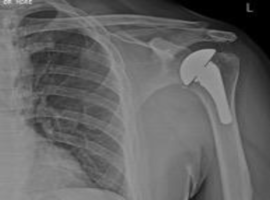
Reduced Humeral Component Retroversion as a Preventive Strategy to Avoid Recurrent Posterior Instability in Seizure Induced Posterior Dislocations with Severe Bone Loss
Abstract

We present the case of a 52-year-old male with an atraumatic, locked posterior dislocation of the left shoulder with approximately 50% humeral head bone loss, requiring hemiarthroplasty. Given the strong suspicion of an underlying seizure disorder, the humeral component was implanted with reduced retroversion of 10° to enhance posterior stability. Six weeks later, the patient experienced an undiagnosed nocturnal seizure, resulting in a locked posterior dislocation of the contralateral shoulder that likewise required hemiarthroplasty. Despite the convulsive event, the initial prosthesis remained stable without evidence of redislocation. Neurologic evaluation ultimately confirmed a seizure disorder. This case highlights sequential bilateral posterior shoulder dislocations as the initial manifestation of an undiagnosed seizure disorder and suggests that individualized humeral component version may be an important surgical consideration for patients at risk of recurrent seizure-associated posterior instability.

Keywords: Bilateral posterior shoulder dislocation; Humeral retroversion; Hemiarthroplasty; Shoulder arthroplasty; Reverse Hill-Sachs lesion; Light-bulb sign